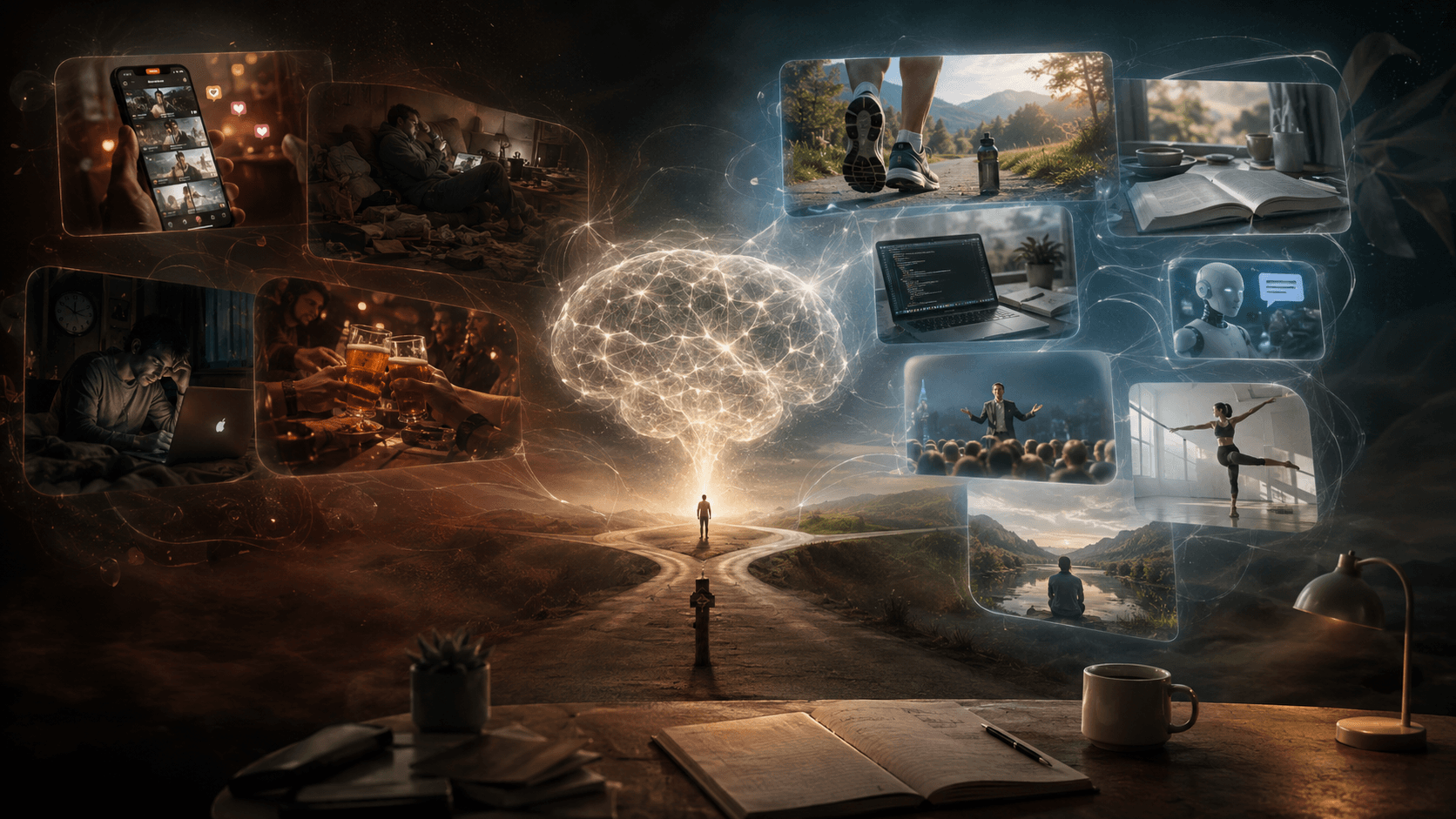
What changing one ordinary habit made me question about the brain, confidence, learning, desire, social media, AI and the way we live
I wanted to experiment with something my brain normally expected, just to see what would happen when I deliberately changed the pattern.
Over the years, I have met people who challenged themselves in different ways. No alcohol for a year. Exercise every day. No partying for months. No social media. No sugar. Waking up early every morning.
I have always found these experiments interesting.
Not because I think everybody needs extreme rules, but because I am curious about what happens when we stop giving ourselves something that has slowly become normal.
So I tried my own version.
For the last three months, I haven't had beer or alcohol.
Alcohol was never a serious problem for me. I wasn't drinking every day or constantly thinking about drinking. It was mostly connected to certain situations.
Friday evening.
Dinner with friends.
Someone's house.
A football match.
A business conversation somewhere casual.
Beer somehow belonged there.
I am also not saying I will never drink again. Maybe I will.
What interested me was something else.
After enough time, not drinking started feeling normal too.
That made me think about a much bigger question:
How many things in our lives feel natural simply because we have repeated them enough times?
And how many things that we describe as our personality may actually be behaviours our brain has become very familiar with?
I Have Always Asked Why
I think I have always questioned things.
Even when I was a child, I remember questioning ideas that people around me seemed to accept without thinking much about them.
Religion was one of them.
I wasn't necessarily trying to prove anyone wrong. I just wanted to understand.
Why do we believe this?
Why does someone born somewhere else believe something completely different?
Why can something feel obviously true to one person and completely wrong to another?
As I became older, the questions changed.
Why can somebody speak confidently with friends but suddenly struggle in front of 100 people?
Why can a normally confident person behave completely differently around someone they find attractive?
Why do we know we should exercise, clean the room, study or finish some work, but still keep delaying it?
Why can we watch short videos for an hour without much resistance, while 20 minutes of learning something difficult can feel exhausting?
Why do some people repeatedly return to alcohol, pornography, gaming, social media or other behaviours even when they have already decided they want to reduce them?
Why do we watch almost the same kind of video again and again?
Sometimes we already know what is probably going to happen.
It gives us almost nothing.
Still, we wait for the next one.
Then the next one.
Then the next one.
I am not a neuroscientist.
I have learned about these things because I am curious. I have listened to researchers and podcasts, including Andrew Huberman's, read papers and articles, asked LLMs questions, compared explanations and then looked at what I actually observe in everyday life.
And sometimes I discovered that the simple neuroscience we hear online isn't quite right.
"Your dopamine is finished."
"Do something for 21 days and it becomes permanent."
"The prefrontal cortex controls everything."
"10,000 hours makes anyone a master."
"Social media destroys your brain."
Real neuroscience is more complicated.
But one basic idea has remained incredibly useful to me:
The brain adapts to what we repeatedly ask it to do.
What Is the Prefrontal Cortex Actually Doing?
One part of the brain kept appearing when I researched attention, confidence, decision-making, working memory and self-control.
The prefrontal cortex.
It is part of the cerebral cortex at the front of the brain.
People sometimes call it the "CEO of the brain."
That is an easy way to explain it, but it is too simple.
There isn't one small boss inside our head controlling everything.
The prefrontal cortex works with many other systems. It is particularly important for things such as keeping current goals active, working memory and goal-directed behaviour.
Imagine deciding:
I am going to study for 30 minutes.
Five minutes later your phone lights up.
Now there are two possible actions.
Continue studying.
Check the phone.
One is connected to something you want in the future.
The other might reward you right now.
Your brain has to keep the original goal active while another behaviour competes for attention.
Versions of this happen all day.
Continue working or open Instagram.
Go to the gym or stay on the sofa.
Finish cleaning or watch another video.
Sleep or keep scrolling.
Think about the problem or immediately ask AI.
Understanding this made me stop thinking about self-control simply as:
strong person vs. weak person.
Environment matters.
Repetition matters.
What is available matters.
How easy the behaviour is matters.
And what we have done in the same situation hundreds of times before matters.
Why Difficult Things Eventually Feel Normal
Driving is a perfect example.
Think about a first driving lesson.
Mirror.
Clutch.
Gear.
Steering.
Brake.
Road.
Pedestrians.
Signs.
Cars around you.
Someone beside you is also telling you what you forgot.
It can feel like your brain has reached maximum capacity.
A few years later, that same person can drive down a familiar road while having a conversation.
The car didn't become easier.
The brain and body became better at operating it.
Something similar happens with typing.
At first you search for individual letters.
Later your fingers move without consciously thinking about every key.
Cooking works this way.
Football.
Playing piano.
Dance.
Speaking another language.
Motor learning involves several interacting brain systems, including motor cortical regions, the basal ganglia and cerebellum. Different parts contribute to movement planning, selection, prediction, correction and learned skilled behaviour.
For me, the most useful lesson isn't remembering the names of all those regions.
It is changing the meaning of the initial difficulty.
When something feels awkward, instead of immediately thinking:
I'm bad at this.
I increasingly try to think:
My brain doesn't have an efficient version of this yet.
That is a completely different message.
Physical Learning Feels Different
I notice this especially when learning physical tasks.
Give me a technical problem.
Something about AI.
An algorithm.
A business question.
Something I need to research.
I can often sit with it for a long time.
But give me something where several parts of my body need to coordinate with memory and timing, and there is much more resistance at first.
Dance is a good example.
Your left foot has one job.
Your right foot has another.
Your hands are doing something different.
Music is playing.
Timing matters.
Balance matters.
You are watching another person.
You need to remember what comes next.
My brain's first response can almost feel like:
No. Too much.
Then something interesting happens.
You repeat it.
Again.
Again.
Slowly, pieces start connecting.
Eventually a movement that required full attention begins happening with much less conscious effort.
We normally see skilled people after this process has already happened.
The chef looks natural.
The dancer looks natural.
The football player looks natural.
The pianist looks natural.
What we don't see are the thousands of awkward repetitions that came before the movement looked natural.
Why Learning Can Make Us Tired
This also explains something I used to wonder about.
Why can we spend hours doing something familiar but become tired quickly when trying to learn something completely new?
One reason is working memory.
Working memory is a temporary mental workspace. It helps us keep information active while we are using it.
But that workspace is limited.
Under some experimental conditions, especially when rehearsal and grouping are controlled, research suggests a central capacity of roughly three to five meaningful chunks of information. That isn't a universal limit for everything a person can think about, but it shows how small active mental workspace can be.
Think again about learning a dance.
Feet.
Hands.
Timing.
Next movement.
Music.
Previous mistake.
The workspace fills quickly.
Programming can feel similar when you're beginning.
What does this variable contain?
What happens inside this loop?
Why did this function fail?
What was the previous value?
Where did this object come from?
After enough experience, many little details become larger familiar patterns.
An experienced programmer doesn't read every character independently.
An experienced driver doesn't consciously calculate every movement of the clutch.
This is part of why learning feels so different from knowing.
Why I Like 15-Minute Experiments
Because of this, I started experimenting with shorter learning blocks.
Usually around 10 or 15 minutes.
There is nothing scientifically magical about exactly 15 minutes.
It simply works for me.
Fifteen minutes speaking another language.
Stop.
Fifteen minutes solving something without AI.
Stop.
Fifteen minutes learning a physical movement.
Stop.
Come back later.
There is a big psychological difference between saying:
"I need to study Spanish for two hours."
And:
"I need to speak Spanish for 15 minutes."
The second one is much harder for my brain to reject.
Sometimes 15 minutes naturally becomes 30.
The important thing was getting past the resistance to starting.
Why Can Scrolling Feel Easier Than Cleaning?
This is one of the strangest things about human behaviour.
Someone can understand a complicated technical problem and still spend an hour avoiding something that would take ten minutes to clean.
Cleaning is objectively easier.
But objective difficulty isn't the only thing influencing behaviour.
Effort matters.
Immediate reward matters.
Uncertainty matters.
Environment matters.
Previous habits matter.
Cleaning gives you satisfaction after doing the work.
Your phone can offer something interesting immediately.
Open the app.
Video.
Nothing interesting.
Swipe.
Another.
Nothing.
Swipe.
Then suddenly:
Something funny.
Something attractive.
Something surprising.
Something that makes you angry.
Something about football.
Something you completely agree with.
And we continue.
Social media didn't invent curiosity.
It didn't invent attraction.
It didn't invent gossip.
It didn't invent our desire for approval.
It didn't invent novelty.
It simply became incredibly good at delivering all of them instantly.
Why Do We Keep Waiting for the Next One?
This is where dopamine often enters the conversation.
Online, dopamine is sometimes described almost like fuel.
Watch too much TikTok?
Dopamine gone.
Play games?
Dopamine gone.
Watch pornography?
Dopamine receptors destroyed.
Avoid everything enjoyable for seven days?
Dopamine reset.
That is far too simple.
Dopamine has important roles in motivation, learning and how the brain updates expectations about rewards. It isn't simply a pleasure tank that empties and refills.
For everyday behaviour, I find a different question more helpful:
What is my brain expecting might happen next?
Maybe the next video is interesting.
Maybe the next notification matters.
Maybe the next message is important.
Maybe the next post makes me laugh.
Maybe the next person I swipe on is different.
Sometimes what keeps us going isn't that every reward is great.
It is that the next one might be.
Sexual Desire, Pornography and Another Modern Habit Loop
There is another area where discussions about habits and the brain often become either moralistic or scientifically exaggerated.
Sexual desire.
Pornography.
Masturbation.
Sexual desire itself is part of normal human life.
Masturbation by itself is not evidence that somebody has damaged their brain.
Pornography use also does not automatically mean someone has a disorder.
The important distinction is what happens when sexual behaviour becomes repeatedly difficult to control and begins causing significant problems in someone's life.
The WHO's ICD-11 includes compulsive sexual behaviour disorder among impulse-control disorders. That is very different from saying sexual desire itself is a disease.
Research into problematic pornography use exists, but the field still contains important uncertainties. For example, a 2024 systematic review of treatments for problematic pornography use found that the available intervention evidence was generally low or very low quality. That should make us careful about confident online claims that scientists have already solved exactly what pornography does to everybody's brain.
What interests me here is not moral judgment.
It is the same question that appears with other habits:
What has become connected to the behaviour?
Bored?
Pornography.
Stressed?
Pornography.
Lonely?
Pornography.
Can't sleep?
Pornography.
Saw something sexual while scrolling?
Continue searching.
Again, this does not mean everyone experiencing these behaviours has an addiction.
It means cues can matter.
The place matters.
The time of day matters.
Being alone can matter.
A phone can matter.
Boredom can matter.
Stress can matter.
And repetition can make one behaviour increasingly familiar as a response to those situations.
The question I find useful is not:
Is sexual desire bad?
It is:
Am I choosing what I do with that desire?
Can someone feel an urge without automatically acting on it?
Can they change the behaviour when they decide they want to?
Is it interfering with sleep, work, relationships or daily life?
Has it become the automatic response to boredom, stress or loneliness?
Those questions are more useful than simply calling everything an addiction.
What Happens When Attraction Moves Onto a Screen?
There is another part of modern life worth thinking about.
For most of human history, people did not carry a device that could show them hundreds of attractive people within ten minutes.
Now we can.
Instagram.
TikTok.
Pornography.
Dating apps.
Short videos.
Recommended content.
New face.
Swipe.
New person.
Swipe.
Another.
Another.
Another.
I don't think we yet understand everything this means for human attraction and relationships.
I also don't think we should pretend the science says more than it does.
But it raises an interesting question.
What expectations are we building when attraction is repeatedly experienced through unlimited choice, fast novelty and almost zero social risk?
Real attraction between two people is slower.
You talk.
You might feel awkward.
You don't know whether they like you.
You discover their personality.
Maybe they reject you.
Maybe you misunderstand each other.
Trust takes time.
Intimacy takes time.
Relationships contain compromises that no swipe interface needs to deal with.
Maybe that difficulty isn't simply an inconvenience.
Maybe some of it is part of learning how to connect with another human being.
The Same Question Appears Everywhere
At first these subjects seem completely unrelated.
Beer.
Instagram.
Pornography.
Procrastination.
Gaming.
Public speaking.
Dating.
Cleaning your apartment.
Learning Spanish.
AI.
But underneath them, I keep seeing some of the same questions.
What triggers the behaviour?
What am I expecting?
What am I avoiding?
What have I repeated?
How difficult has the alternative become?
And most importantly:
How much choice do I still have?
For one person, an experiment might mean no alcohol for several months.
Someone else might stop pornography for a while.
Someone might delete social media.
Someone might exercise every morning.
Someone might stop using dating apps.
Someone might spend one hour every day learning without AI.
The point isn't that everybody needs the same restriction.
The interesting part is discovering what happens when we interrupt something our brain has learned to expect.
We Have Almost Eliminated Boredom
Think about how many empty moments we have removed.
Waiting for someone?
Phone.
Eating alone?
Phone.
Bathroom?
Phone.
Bus?
Phone.
Can't sleep?
Phone.
Just woke up?
Phone.
Walking somewhere?
Podcast, music or phone.
There is almost always something available.
I don't think technology is automatically bad because of this.
I use technology constantly.
But I started wondering whether boredom had some value we never appreciated.
Some of my best ideas appear when almost nothing is happening.
Walking.
Sitting somewhere.
Looking outside.
Thinking about one problem without immediately searching for an answer.
Sometimes I now deliberately leave that space empty.
Not because being bored magically repairs the brain.
I just want to see what my own mind does when nobody else is continuously putting information into it.
Confidence May Be More Trainable Than It Feels
Public speaking made me think about the brain in another way.
Imagine someone who knows a subject extremely well.
Ask them privately and they can explain everything.
Now place them in front of 100 people.
Suddenly they aren't only thinking about the subject.
They may also be thinking:
What do they think about me?
Why is that person staring?
Am I speaking too quickly?
Where should I put my hands?
Did I say that correctly?
What happens if I forget something?
Their knowledge didn't disappear.
Their attention now has more things competing for it.
Dating can produce something similar.
Speaking a second language can do it.
Entering a room full of strangers can do it.
Talking to someone you find attractive can do it.
I used to think confidence was mostly something people either had or didn't have.
Now I think repeated experience plays a major role.
Someone who has spoken publicly 200 times has experienced that uncomfortable situation 200 times.
They might still feel nervous.
But it isn't completely unknown anymore.
Someone who has spoken Spanish badly hundreds of times has learned something valuable too:
A mistake is survivable.
Maybe confidence isn't always:
I don't feel fear.
Sometimes it is:
I know this feeling, and I know I can still function while feeling it.
What Alcohol Made Me Notice About Context
This brings me back to the experiment that started these thoughts.
Alcohol wasn't something I was fighting with.
What interested me was association.
Friday could suggest beer.
Dinner with friends could suggest beer.
Football could suggest beer.
A relaxed business conversation could suggest beer.
Then I spent months having many of those experiences without alcohol.
Eventually that became normal too.
Alcohol does affect brain function, and misuse can interfere with areas involved in memory, judgment, balance and behaviour. But that is very different from claiming that every person who drinks socially has brain damage or that a few months without alcohol performs some magical neurological reset.
I don't need that exaggerated story.
What I learned was much simpler.
A behaviour can feel natural partly because we have repeatedly connected it with the same situation.
Maybe I will drink again.
That is fine.
The difference I care about is:
Did I choose it, or did the situation make the decision before I even thought about it?
Social Media and the Next Generation
This question becomes bigger when I think about children growing up now.
My generation experienced at least some life before everything became permanently connected.
We remember being bored.
We remember going somewhere without internet.
We remember not being reachable every minute.
We remember television programmes actually ending.
Children growing up now may experience something very different.
An algorithm can start learning what holds a child's attention before that child knows what an algorithm is.
I don't think it is responsible to say social media is simply "destroying children's brains."
The research is more complicated.
But there are reasons to pay attention.
A 2025 JAMA study followed social-media-use patterns in 6,554 young people from roughly ages 9 to 13. Increasing social-media use was associated with somewhat poorer later performance on several cognitive measures compared with very low use. Importantly, this was an association. It does not prove that social media directly caused those cognitive differences.
Still, it makes the question worth asking:
What happens when an entire generation trains its attention inside systems designed around constant novelty and switching?
We don't completely know.
The experiment is happening now.
Then We Added AI
And now things get even more interesting.
I love AI.
I build with it.
I use LLMs constantly.
They have made learning unbelievably powerful.
If I don't understand something, I can keep asking:
Why?
Explain it differently.
Give me an example.
What evidence supports this?
What evidence goes against it?
What am I misunderstanding?
Twenty years ago, getting that depth might have required finding several books, specialists or teachers.
Now curiosity can continue immediately.
That is extraordinary.
But there is another possibility.
There is a difference between:
Using AI because I want to understand more.
And:
Using AI because I don't want to think.
From the outside, both look exactly the same.
Someone typing into ChatGPT.
But what happens before and after that prompt can be very different.
Two People, Same AI
Imagine two programmers facing the same problem.
Person One
Reads the problem.
Thinks.
Writes something.
It fails.
Reads the error.
Changes something.
Fails again.
Forms another idea.
Then asks AI:
"Here is what I tried. What am I missing?"
Person Two
Sees the problem.
Copies it.
Pastes it into an LLM.
Copies the answer.
Done.
Both finished the task.
Both used AI.
But did they train the same ability?
Probably not.
One spent more time solving.
The other became extremely efficient at obtaining an answer.
Both abilities can be useful.
But they are not identical.
We Already Have a Small Warning About AI and Thinking
Microsoft researchers studied hundreds of real examples of knowledge workers using generative AI. Workers reported putting less effort into critical thinking when they had greater confidence in AI, while the technology also shifted some thinking toward checking, integrating and supervising AI outputs.
That doesn't prove ChatGPT makes people stupid.
I don't believe that conclusion is justified.
The more interesting lesson is:
AI can remove some forms of thinking while creating or increasing other forms of thinking.
The result depends partly on how we use it.
That may become one of the most important skills of the next generation.
What Happens to Children Who Grow Up With AI?
A child growing up today may eventually never know a world without instant intelligent assistance.
Don't understand something?
Ask AI.
Homework difficult?
Generate it.
Writing difficult?
Generate it.
Need code?
Generate it.
Need an idea?
Generate it.
Need an image?
Generate it.
There is an easy version of the future where this sounds frightening.
But there is another version.
A child asks:
Why is the sky blue?
AI explains.
The child asks:
Why does blue light scatter more?
Then:
Would the sky be different on Mars?
Then:
What happens during sunset?
Then:
Can we create an experiment at home to demonstrate it?
That child might explore a question much further than previous generations could.
So I don't think the important divide will be:
People who use AI vs. people who don't.
Almost everyone will use it.
The more interesting divide may become:
People who use AI to avoid thinking vs. people who use AI to extend their thinking.
My Rule Is Attempt Before Assistance
I have started using a simple rule for myself.
Attempt before assistance.
Not always.
If AI can save three hours of repetitive work, use it.
If software can automate something that teaches me nothing, automate it.
If I simply need information, find it quickly.
But when the ability itself matters, I want my brain involved first.
Try to remember the Spanish word before translating it.
Try the coding problem before generating the solution.
Form an opinion before asking an LLM what it thinks.
Read enough of the research to understand the problem before asking for a summary.
Think about the business problem before asking for twenty ideas.
Then use AI.
Challenge my answer.
Find what I missed.
Show me the counterargument.
Explain the difficult part.
Take the idea further.
Make me faster.
Instead of:
Think instead of me.
It becomes:
Think with me.
Some Friction Is the Workout
Technology has spent decades removing friction.
Usually that is progress.
I don't need to memorise every street because GPS exists.
I don't need to manually search through 5,000 documents if software can do it.
I don't need to calculate everything on paper to prove that I understand mathematics.
Removing useless difficulty is good.
But sometimes the difficulty is where the ability develops.
Trying to remember the word.
Trying to solve the bug.
Trying to speak when the sentence isn't perfect.
Trying to coordinate your hands and feet.
Trying to explain your own opinion.
Trying to tolerate rejection.
Trying to sit with a difficult problem.
Trying to stay in a conversation when you feel uncomfortable.
Trying something you're bad at.
Those moments feel inefficient.
But sometimes:
The friction is the workout.
We should remove useless friction.
I think we should be more careful before removing every useful form of friction too.
I Don't Want to Become a Monk
I still use social media.
I still waste time.
I still delay things I know I should do.
I use AI every day.
Maybe I will drink beer again.
This isn't about removing pleasure.
It isn't a dopamine detox.
It isn't about becoming a perfectly disciplined machine.
That isn't how I want to live.
What I want is much simpler:
I want to notice my defaults.
And occasionally challenge them.
Fifteen minutes speaking another language.
Fifteen minutes solving something without AI.
Fifteen minutes learning a physical movement.
Do the boring task before opening social media.
Walk sometimes without consuming content.
Experience some boredom.
Talk even when I feel uncomfortable.
Try something I know I will initially be bad at.
Give the brain another experience.
Another repetition.
Another option.
Maybe We Mistake Repetition for Identity
After watching myself and people around me, this is probably the part that interests me most.
We describe ourselves using permanent language.
"I'm lazy."
"I'm not confident."
"I'm terrible at languages."
"I can't dance."
"I don't have discipline."
"I can't concentrate."
Sometimes those statements accurately describe something we struggle with today.
But:
"This is difficult for me right now"
and
"This is permanently who I am"
are completely different statements.
Of course repetition does not explain everything.
Biology matters.
Genetics matter.
Childhood matters.
Personality matters.
Environment matters.
Education matters.
Mental and physical health matter.
Luck matters.
Humans are complicated.
But experience matters too.
The brain learns.
The brain adapts.
Familiar things usually require less conscious effort than unfamiliar ones.
That gives me an optimistic way to look at habits.
I don't have to assume every behaviour I currently repeat is some permanent part of who I am.
Some of it may simply be something I became very good at repeating.
And if repeated experience helped build one pattern, maybe repeated experience can help build another.
What Are We Training Our Brains to Become?
Every time we automatically reach for the phone when bored, we reinforce something.
Every time we stay with a difficult problem a little longer, we reinforce something.
Every time we avoid an uncomfortable conversation, we reinforce something.
Every time we speak despite feeling uncomfortable, we reinforce something.
Every time boredom automatically leads to a screen, we reinforce something.
Every time an urge automatically produces the same response, we reinforce something.
Every time AI does all the thinking for us, we reinforce something.
And every time we use AI to challenge our own thinking, we reinforce something different.
Not every behaviour needs to be optimised.
Not every pleasure needs to become a productivity experiment.
Life should still be life.
But every once in a while, I think it is worth stopping and asking:
Am I choosing this because I actually want it, or has repetition already started choosing it for me?
That was what three months without alcohol unexpectedly made me think about.
Not really alcohol.
Choice.
And maybe that is the bigger experiment worth continuing.
Are you choosing your habits, or are they choosing you?