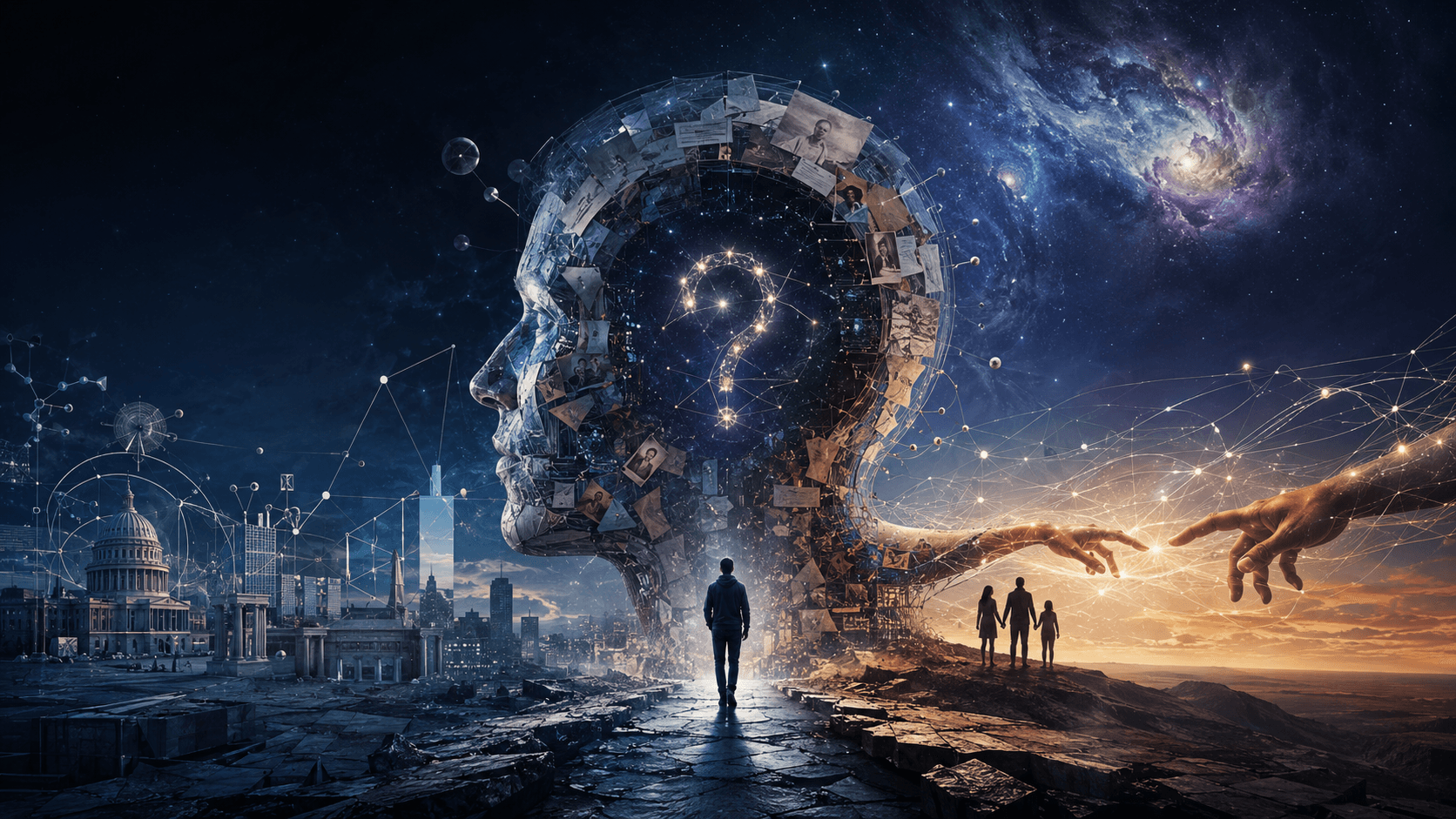
Politics sells it, religion organizes it, love depends on it, and none of us can live without it. So when does belief become dangerous?
I often hear people say, “I believe in God,” “I believe in science,” “I believe this political party is right,” or simply, “I believe in myself.”
The same word is used for religion, technology, politics, love, money and our own future. But these are not the same kind of claim. Believing that the sun will rise tomorrow is not the same as believing that one political party will save a country. Believing that I can improve is not the same as claiming that I will become rich while doing nothing differently.
So what do we actually mean when we say, “I believe”?
Sometimes it means, “I have enough evidence.” Sometimes it means, “I trust this person.” Sometimes it means, “I hope this is true.” And sometimes, if we are honest, it means, “I need this to be true because I do not know how to live without it.”
That is where my question begins.
Why am I writing this?
Maybe I am writing this because I have watched people believe stories about other people without checking where those stories came from.
Living abroad has made me notice this more. Some people who leave their country start speaking as if they understand everything happening there better than the people still living inside it. They see one video, read one post, hear one opinion and then explain corruption, money, power and motivation as if the whole country is visible from a distance.
I have seen the same pattern in Nepal, India, the United States and elsewhere. People do not only ask, “Is this true?” They often ask, “Does this fit what I already want to believe?”
That question is personal for me because I have watched people turn admiration into hatred almost overnight.
We cannot live only with proven facts
At first, I wondered whether belief itself was the problem. Why should we accept anything without scientific proof?
But that question is too simple. Human life cannot wait for complete proof.
I believe a chair will hold me before I sit on it. I trust that a friend will keep a promise. A founder builds a product before knowing whether anyone will buy it. A scientist begins an experiment because a hypothesis might be true. None of these people possesses certainty. They act on different mixtures of evidence, experience, trust and probability.
Even science does not begin with certainty. It begins with questions, observations and hypotheses. What makes science powerful is not that scientists never believe anything. It is that scientific claims are supposed to remain open to testing, criticism and revision.
Science is not a collection of eternal declarations. It is a disciplined way of being wrong less often.
This distinction matters. A scientific model can be our best current explanation without being the final truth about reality. Evidence can make one explanation far more credible than another, but scientific confidence is normally proportional, not absolute.
The problem, then, is not that we believe before we know everything. We have no other way to live. The problem begins when we forget the distance between belief and knowledge.
The mind is not a neutral courtroom
We like to imagine that we first examine the evidence and then form a belief. Often, the order is reversed. We inherit a belief from family, culture, political identity or personal experience, and then look for reasons to defend it.
This does not mean every belief is irrational. It means the human mind is not a neutral courtroom in which every piece of evidence receives equal attention.
Research on confirmation bias suggests that confidence can change how people process new information. Evidence consistent with an existing decision may receive more weight, while contradictory evidence may receive less. Political identity can intensify this process because changing an opinion may feel like betraying one’s group, not merely correcting a factual error.
Beliefs do more than describe the world. They can protect identity, preserve relationships, reduce uncertainty and give suffering a meaning. That is why facts alone do not always change minds. You may be challenging a proposition, but the other person may feel that you are challenging their family, dignity or entire way of life.
The internet makes this easier. We can now find a confident person, a selective statistic and a polished video to support almost any conclusion. Consumption feels like investigation, although we may simply be training an algorithm to show us our own reflection.
We do not only believe what we see. Increasingly, we see what our beliefs have taught the system to show us.
Religion, atheism and the honesty of uncertainty
Religion makes the question of belief obvious. One person says, “I believe God has a plan.” Another says, “I believe there is no God.” An agnostic says, “I do not know.”
These positions should not be flattened into identical claims. Some religious beliefs are based on faith, revelation, tradition or personal experience. Atheism can mean a positive conviction that no gods exist, but it can also mean simply lacking belief in any god. Agnosticism usually concerns knowledge: the person does not claim to know whether a god exists. Someone can therefore be both agnostic and atheist, or agnostic and religious, depending on how the words are defined.
Labels help us communicate, but they can also create an illusion that uncertainty has been solved. Calling myself an agnostic does not explain why the universe exists, why there is something rather than nothing, what consciousness ultimately is, or whether reality has a purpose. It only describes the limits of my present claim.
Personally, I do not believe in religion as it currently exists in our world. I see religions as human-made systems: institutions built through human language, stories, rituals, laws, statues, symbols and authorities. That does not prove that every spiritual experience is false, or that nothing exists beyond what we can currently measure. It means I see no sufficient reason to accept that a particular institution possesses the final explanation of reality.
People pray to a statue, repeat a sacred name, visit a particular place, donate money or follow a religious leader because they believe some power will hear, protect, forgive or reward them. The statue itself is made by human hands. The name comes through a human language. The institution collects and manages money through human decisions. If a divine reality exists, why assume that it is limited to our objects, borders, books or organizations?
Religion can do real good. Religious communities feed people, run hospitals and schools, support families, preserve culture and give lonely or grieving people somewhere to belong. Money gathered through belief can relieve suffering. But the same machinery can also produce wealth, manipulation, fear, exclusion, abuse, political control and violence. Money gathered in the name of goodness can help the vulnerable, or finance something cruel. A sacred label does not automatically purify a human action.
This is why I think religion can become a business, but saying only that would also be incomplete. It can be a community, identity, moral tradition, psychological shelter, political machine and business at the same time. Different people experience different parts of it. The existence of charity does not prove the theology, just as the existence of corruption does not prove that every believer is insincere.
I can reject organized religion without claiming that I have solved the universe.
Perhaps reality contains a power or structure far beyond human understanding. Perhaps what people call God is not a person watching us, but something closer to the source, law or intelligence from which the universe emerged. Perhaps our universe is part of a larger reality, one layer among many, or even something analogous to a simulation. These possibilities are fascinating. They are not established facts. Moving the mystery one level higher also does not solve it. If a creator made our universe, what explains the creator? If we live in a simulation, what explains the world containing the simulator?
“Something greater may exist” and “my religion knows exactly what it is” are two very different claims.
Perhaps the most honest sentence in many religious and metaphysical debates is not “I believe” or “I do not believe.” It is “I do not know, but here is what seems plausible to me, and here is why.”
That sentence is less dramatic. It is also more difficult, because uncertainty gives us no tribe, no final answer and no guarantee that our life fits into a cosmic plan.
Still, uncertainty is not emptiness. It is intellectual space.
Technology has beliefs too
People in science and technology sometimes speak as if belief belongs only to religion. But technology is full of beliefs disguised as inevitabilities.
Some believe advanced AI should be open because access distributes power, enables scrutiny and accelerates innovation. Others believe powerful models should remain closed because unrestricted access may increase misuse and concentrate accountability nowhere. Evidence and real risks exist on both sides, but the final position also depends on values: which risks matter most, who should hold power, and what kind of future we want.
The same is true when we ask whether robots or digital beings could become our companions, lovers or sexual partners. We can investigate attachment, embodiment, consciousness, safety and social effects. But science alone cannot decide what should count as intimacy, whether simulated affection is meaningful, or which relationships society ought to accept. Those are partly empirical questions and partly moral choices.
When someone says, “Robots will never be real partners,” that may be a prediction, an emotional reaction or a definition of the word real. When another person says, “Humans will fall in love with AI,” that may be plausible, but plausibility is not proof. Humans already become emotionally attached to fictional characters, voices and machines. What that attachment will become is still an open question.
We should not confuse a future we can imagine with a future that must arrive.
Political belief and borrowed certainty
Political parties also sell more than policies. They sell explanations, enemies, identities and belonging.
A supporter may say, “I believe this party cares about ordinary people.” But what would prove that? Its manifesto? Voting record? Economic results? The character of its leader? A story on the news?
Different people select different evidence, often after choosing a side. Then every success belongs to their party and every failure requires an excuse. The opposing side behaves in the same way.
This is borrowed certainty. We let a group do the thinking and receive confidence in return.
The most interesting political belief often appears when an old system has disappointed people. A new party rises. Its leaders are younger, educated, technically confident and free from the visible failures of those who governed before. People do not merely support it. They pour all their unfinished hope into it.
“They are young, so they will be honest.”
“They are educated, so they will know what to do.”
“They are new, so they cannot be corrupt.”
None of these conclusions necessarily follows. Youth may bring energy, but not administrative experience. Education may improve analysis, but it does not guarantee judgment, courage or integrity. Being new means a party has fewer recorded failures, not that it is incapable of failing.
Then the party wins and meets reality. Government is slower than a campaign. Laws require negotiation. Institutions resist change. Budgets are limited. International conditions interfere. Some promises were unrealistic from the beginning. Other promises were sincere but poorly executed. A few may be abandoned once power becomes more valuable than principle.
Supporters expected transformation and received administration.
When change does not arrive fast enough, belief starts to crack. The opposition uses every delay as proof of incompetence. Former supporters feel betrayed because they did not invest only a vote. They invested their hope. Soon another movement emerges, newer and purer, promising to do quickly what the previous saviour could not. The public transfers its hope again, and the cycle restarts.
This does not mean new parties should never be trusted or ambitious promises should never be made. Political renewal is sometimes necessary. But hope is not a governing system. A serious political judgment should ask what can legally be changed, how long it should reasonably take, what it will cost, what trade-offs are hidden, which institutions must cooperate, and what measurable progress should appear along the way.
We should distinguish four different failures: an impossible promise, a broken promise, a delayed promise and a policy that was attempted but did not work. Opposition parties benefit when the public treats all four as identical. Governments benefit when the public treats all four as unavoidable. Neither is honest.
Politics uses belief most effectively by turning patience and outrage on and off. The government asks believers to wait. The opposition tells them that every delay is betrayal. Both sides compete to control not only the facts, but the emotional meaning of the facts.
The healthier position is not to believe that all parties are equally bad or that every claim is propaganda. That is another lazy certainty. The better habit is to judge claims individually, compare them with observable results, and remain willing to criticize the group we normally support.
Loyalty should never be more permanent than evidence.
One example of the larger problem
The main point here is not one person. It is how quickly belief can turn a person into a story, and then make that story difficult to question.
I saw this in the changing public reaction to Shrinkhala Khatiwada in Nepal. I knew who she was through the Hetauda context later in life, but we never met. I do not know her private life, every decision she made or everything behind the accusations against her. That limitation is important. I am not writing as someone who knows the truth about her. I am writing as someone who noticed how quickly other people became certain that they did.
She had once been widely admired. Over time, rumours about relationships, her later marriage, the reputation people attached to the family she married into, and her parents’ political backgrounds were combined into one larger story about who she supposedly was. Some people believed she had chosen wealth and power over another person. Others treated access to a relatively comfortable life as evidence of corruption. Once that story formed, almost anything she did could be interpreted as further proof.
Some facts are public. Her father, Birodh Khatiwada, is a politician, and her mother has also held political office. She had opportunities and a level of security many Nepalis did not have. It is reasonable to discuss privilege, political families and unequal access. But privilege is not identical to corruption, and being related to politicians does not prove that every achievement or possession came from stolen public money.
The hostility did not begin only when she was criticised for her response during Nepal’s later Gen Z unrest. It had already developed through years of social-media stories, relationship speculation and assumptions about status. The 2025 “nepo baby” campaign made it much larger. Media reports described her losing around 100,000 followers. She then released statements and financial explanations, denying that she had misused public money or received unfair political advantage.
After listening to her explanations and looking at the information she presented, I believed her side. I still do. She did not offer only a denial. She tried to explain where her opportunities, travel and money came from and responded to the story being built around her. To me, that was meaningful evidence. Yet many people appeared unwilling to reconsider because they had already decided what kind of person she was.
This does not mean I possess mathematical proof that every part of her account is true. Documents can be incomplete. Stories can be edited. Evidence itself can sometimes be fabricated. I live far from Nepal now and do not follow every event there closely. I may be missing important information.
But belief does not require pretending that every possibility is equally likely. Based on what I knew, what she presented, how the accusations developed and what I have observed about social-media influence, I thought her account was more believable than the story against her.
I have watched TikTok videos, Reels and repeated commentary influence people I know personally, including people around the city where I live. I have seen how one person’s interpretation becomes another person’s fact. A short video removes context, an emotional explanation travels faster than a careful one, and soon people remember the conclusion without remembering where it came from.
Perhaps my connection to Hetauda and the impression I formed of her made me more open to her explanation. That is also a bias I have to admit. But even if the same thing happened to someone I did not know of, I would want to hear that person’s side, examine the evidence from both directions and avoid a final verdict until something stronger appeared.
So my position is more specific than simple neutrality: “Based on the information I have, I believe her. I may not be 100 percent right because I do not know the complete picture, but I will not treat accusations and repetition as proof of guilt.”
That is how much of my thinking works. I do not divide every question into absolute belief and absolute disbelief. I place conclusions somewhere within a range, then move them when better evidence arrives.
People often admire a public figure for years without truly knowing them. Then a controversy appears, and the same person becomes a villain. The audience waits for someone confident to explain what happened and repeats that explanation until repetition feels like evidence. A small mistake, a bad relationship, an unwise friendship or trust placed in the wrong person can then be used to rewrite an entire life.
People do make mistakes. They choose the wrong partner, trust the wrong friend, stay silent at the wrong moment or make decisions that look worse later. Sometimes close relationships pull people into trouble. Accountability still matters, especially for public figures. But one bad decision should be evidence about that decision, not automatic proof that every part of the person was always fraudulent.
Education does not protect us automatically. A person with a PhD and a person who left school early can both reason badly. What matters is how we collect information, compare sources, separate facts from interpretations and update our views.
Sometimes a thousand people repeating a claim only creates a thousand repetitions. It does not create proof.
This happens far beyond Nepal. Influencers, business leaders, actors, politicians and ordinary people across many countries are reduced to stories built from fragments. The details change, but the machinery of belief remains the same: a fragment becomes a story, the story becomes an identity, and that identity begins deciding how every new fact will be interpreted.
The answer is neither blind defence nor automatic condemnation. It is proportion. Verify what can be verified, identify what remains alleged, judge actions individually and leave enough room to admit that the person may be more complicated than the story we believe about them.
Love, family and the beliefs we rarely call beliefs
Love may be one of the most powerful forms of belief because it rarely feels like a theory.
When I say, “This person loves me,” I cannot place the entire relationship under a microscope. I infer love from words, consistency, sacrifice, attention and how the person behaves when love becomes inconvenient. Trust is a belief about what someone will do when I am not watching.
That belief makes intimacy possible. If we demanded proof before every act of vulnerability, no relationship could begin. But love can also become an excuse for ignoring evidence. A person repeatedly lies, controls or harms us, yet we continue believing in the person they promised to become. Hope begins defending what reality keeps disproving.
There is a difference between believing in someone and refusing to see them.
Families transmit beliefs before children are old enough to examine them. Religion, politics, gender roles, honour, success, marriage and duty can arrive as inherited truths. Often this inheritance gives identity and belonging. Sometimes it becomes a cage built from love: “We only want what is best for you,” followed by a life the person never chose.
Parents can genuinely love their children and still be wrong about what those children need. Children can reject a family belief without rejecting the family. Disagreement is not always disrespect. Sometimes it is the first honest conversation a family has had.
Relationships also fail when belief becomes mind-reading. “If you loved me, you would know.” “You will never change.” “Everyone eventually leaves.” These sentences turn fear into fact. We then react to an imagined certainty and may create the outcome we feared.
Healthy love does not require blind belief. It requires trust that remains connected to behaviour, communication that tests assumptions, and enough humility to update the story we hold about another person.
Love needs belief, but love also needs evidence.
Self-belief can help, but it cannot replace a plan
“Believe in yourself” sounds positive, and sometimes it is useful. Psychological research on self-efficacy links belief in one’s capacity to act with persistence and performance in several domains. A person who believes improvement is possible may practise longer, recover from failure and attempt work that fear previously prevented.
But self-belief is not magic.
Saying “I will be the best” does not create skill. Saying “I will be rich” while repeating the same routine does not alter income. Confidence without action can become a comfortable hallucination. It gives us the emotional reward of a future identity without requiring the present sacrifice needed to build it.
I know this tension personally. I can believe I am capable of building meaningful technology. That belief may help me continue after rejection or failure. But my code, experiments, users, discipline and decisions must eventually carry the argument. The world does not owe me the future I can imagine.
A useful belief should produce a testable next action.
“I believe I can become a strong engineer” becomes meaningful when followed by what I will learn, build and measure this week. “I believe this company can succeed” becomes meaningful when followed by which problem it solves, who needs it, and what evidence would make me change direction.
Belief can start the engine. It cannot drive the car for us.
Not all beliefs deserve equal respect
People sometimes say that everyone is entitled to their beliefs. Legally and personally, people should have broad freedom of conscience. But freedom to hold a belief does not make the belief accurate, harmless or immune from criticism.
A private hope is different from a medical claim. A spiritual interpretation of one’s own suffering is different from imposing rules on another person. A prediction about AI is different from deploying an unsafe system and asking society to trust it.
The greater the consequence, the greater the burden of evidence should be.
If my belief affects only how I understand my own life, humility may be enough. If it affects your health, freedom, money or rights, “this is what I believe” is not enough.
Belief becomes dangerous when it is:
- presented as knowledge without sufficient evidence;
- protected from every possible test;
- fused so completely with identity that disagreement becomes an attack;
- used to control people who do not share it;
- preserved even after its real-world predictions repeatedly fail.
The opposite danger also exists. Demanding laboratory proof for every question can become a performance of rationality. Science can examine what happens, what is likely, and what causes what. It cannot, by itself, determine every value or purpose. No microscope can prove how I ought to live. Values require reasoning, experience, empathy and choice.
A better language for belief
Maybe we do not need to stop believing. Maybe we need to speak more precisely.
Instead of saying, “I know,” I can say:
- “The evidence strongly suggests this.”
- “This is my current best explanation.”
- “I trust this, although I cannot prove it.”
- “I hope this is true.”
- “This belief gives my life meaning.”
- “I am about 70 percent confident.”
- “I could be wrong, and this is what would change my mind.”
These sentences may sound weaker than certainty. In reality, they require more strength. Anyone can declare. It takes discipline to expose the foundation of a claim and admit where it ends.
The question I now want to ask when I hear “I believe” is not simply, “Can you prove it?”
I want to ask:
What kind of belief is this? Is it a fact claim, a prediction, a moral value, a personal hope or a statement of identity? What evidence supports it? What evidence challenges it? What would change your mind? And who carries the cost if you are wrong?
Those questions do not eliminate belief. They make it accountable.
What I believe now
I began with the suspicion that belief had become too common and too problematic. I still think we use the word carelessly. We use it to fill the space between what we know and what we want. Then we forget that a space ever existed.
But belief itself is not the enemy.
Without belief, we could not trust, experiment, create, love or move toward a future that has not yet become visible. Every meaningful project begins before its outcome can be known.
The real problem is certainty without proportion. It is treating hope as prediction, identity as evidence, repetition as truth, or confidence as competence.
I do not want a life without belief. I want beliefs that can breathe. Beliefs strong enough to guide action, but not so rigid that evidence cannot enter. Beliefs that give courage without claiming ownership of the truth.
Maybe wisdom is not having no beliefs.
Maybe it is knowing what kind of belief we are holding, why we are holding it, and when it is time to let it go.
Notes and further reading
- Stanford Encyclopedia of Philosophy, “Epistemology” and “The Analysis of Knowledge”, on the distinctions among belief, truth, justification and knowledge.
- Rollwage et al., “Confidence drives a neural confirmation bias”, Nature Communications (2020), experimental evidence that confidence can amplify choice-consistent information processing.
- Ditto et al., “Partisan Bias in Political Judgment”, Annual Review of Psychology (2025), a review of how partisan commitments shape judgment and evidence evaluation.
- American Psychological Association, “Self-efficacy: The theory at the heart of human agency”, on the evidence, uses and limits of beliefs about personal capability.
- The Kathmandu Post report on online harassment surrounding Shrinkhala Khatiwada, earlier reporting about her publicly discussed relationship, and ABC’s 2025 report on the “nepo baby” backlash and her response. I use these sources to distinguish reported events from rumours and unproven accusations.